Chicagoland Renovation in 2026: Where the Money Is Going

- Jun 6, 2026
- 7 min read

Permit records don’t lie. Every time a Cook County homeowner files for a roof replacement, a finished basement, or an HVAC swap, it goes into the public record. Pull those numbers across the county for the first half of 2026 and you get something more useful than any trend report: a real picture of where the Chicagoland renovation market actually is right now.
In the first six months of 2026, Cook County logged 4,128 residential renovation permits across the project types we track. Roofing led with 1,482. Basement finishing came in second at 944. HVAC replacement was third at 680, followed by decks at 631. That ranking isn’t random. It reflects exactly what this housing market is dealing with.
Roofing Leads, and Chicago’s Winters Explain Why
Chicago’s freeze-thaw cycles are harder on roofing materials than most homeowners realize. A roof that lasts 25 years in Phoenix gets 15 in the Chicago metro, because winter puts it through dozens of expansion and contraction cycles that southern climates don’t see. Ice dams form. Flashing cracks. Underlayment degrades faster.
The result is that roofing consistently tops permit charts here in a way it doesn’t in warmer markets. The 1,482 roofing permits filed in H1 2026 represent the highest volume of any project type in Cook County, and the average permit value in Q1 ran to $242,033. That reflects full-scope work: not just shingles, but complete tear-offs with ice-and-water shield underlayment, new flashing, and ridge ventilation. Everything Chicago code requires and Chicago winters demand.
According to the U.S. Census Bureau’s Building Permits Survey, Cook County consistently ranks among the top counties nationally for residential renovation permit volume. The roofing numbers in particular reflect an aging housing stock concentrated in the 1950s through 1980s builds that define much of the metro’s suburban footprint.
Basement Finishing: A Chicagoland Pattern That Doesn’t Show Up Elsewhere
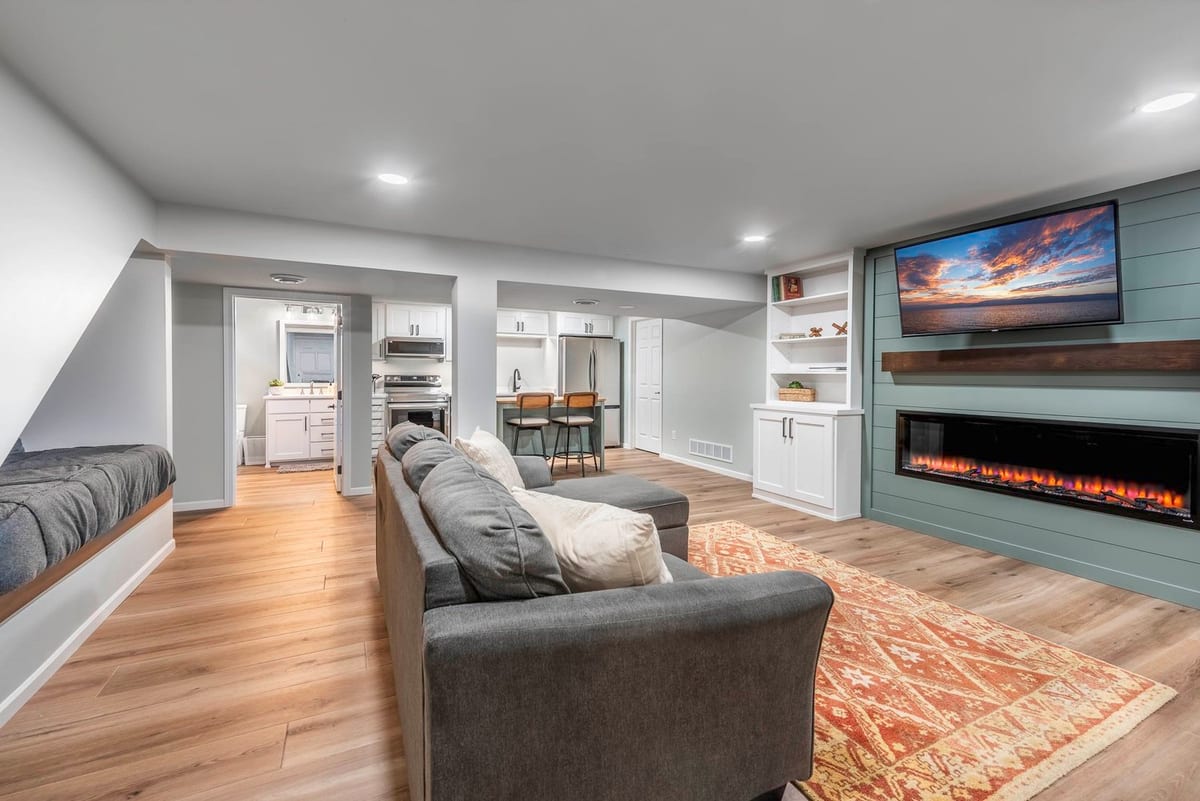
The second-most-active project type in Cook County wouldn’t even register in most Sun Belt markets. In Nashville or Phoenix, finished basements barely appear in permit data. In Chicagoland, they’re a defining feature of the resale market.
Cook County logged 944 basement finishing permits in H1 2026, with an average permit value of $255,149 in Q1. That’s a real investment, not a cosmetic one, and the resale pressure behind it is specific to this region.
In collar county markets (DuPage, Lake, Will), buyers shopping above the local median expect a finished basement. An unfinished one in a $450,000 home is a competitive disadvantage before buyers even walk in the door. Agents flag it. Buyers price it in. The permit data reflects homeowners responding to that reality ahead of listing.
The other driver is Chicago’s older housing stock. Many homes from the 1950s through 1970s have basements that have never been touched, with waterproofing that predates modern standards. A moisture assessment should precede any finishing project. In homes along higher-water-table areas in Cook County, remediation alone can run $2,000 to $15,000 before the finishing work even begins. The average permit value reflects that total scope.
Basement finishing costs and what the project returns in Illinois →
HVAC Permit Values Are Up Even as Volume Falls
HVAC replacement filed 680 permits in H1 2026, down about 23% from the same period in 2025. But the average permit value tells a different story. Q1 2026 came in at $620,518 per permit, reflecting an increase in what homeowners are actually spending per installation, not just in permit count.
Two things happened to HVAC costs in 2026. The federal tax credit that many homeowners planned to use when swapping aging systems expired December 31, 2025. And new refrigerant regulations (the shift away from R-410A under updated EPA rules) added 10 to 30% to equipment costs compared to 2023 pricing. The homeowners who moved forward with replacements in 2026 paid more for their systems than they would have two years ago.
For the Chicago metro specifically, HVAC replacement carries urgency that doesn’t apply the same way in softer climates. Buyers’ inspectors flag systems older than 15 years. A dated unit on a listing in Lincoln Park or Naperville routinely becomes a price negotiation point at the closing table. A recently replaced system doesn’t just protect you from repair costs. It removes a conversation you’d otherwise have with every serious buyer.
HVAC replacement costs in the Chicago metro: what 2026 pricing actually looks like →
Where the ROI Calculation Changes Across Chicagoland Neighborhoods
Permit data tells you what’s being done. Home values tell you whether it pencils out in your specific market. In Chicagoland, those two numbers vary more than almost any other metro in the country.
The median home value across the 308 Chicagoland ZIP codes we track is $349,932. But the range runs from under $200,000 in parts of the south and west suburbs to more than $2 million in Kenilworth (60043) and above $1.5 million in Glencoe (60022) and Winnetka (60093). The same kitchen remodel is a completely different financial decision depending on which of those markets you’re in.
In the North Shore (Kenilworth, Winnetka, Glencoe, Wilmette with a median near $960k), the home value ceiling is high enough that a $80,000 to $100,000 kitchen remodel can move the needle at resale in ways it simply can’t in a $300,000 market. Buyers at that price point expect updated kitchens and pay more for them. The project has room to perform.
In Lincoln Park (60614, median $642k), Bucktown and Wicker Park (60622, $625k), and Naperville (60564, $683k), the ROI calculus tilts toward projects with cleaner returns: HVAC, roofing, and bathroom updates. These neighborhoods have strong buyer competition, fast days-on-market, and enough price point to reward quality finishes without requiring the ultra-premium tier the North Shore demands.
In mid-market Cook County suburbs sitting between $300,000 and $450,000, renovation strategy gets more conservative. Roofing and HVAC replacement are near-mandatory for any homeowner approaching a sale. A kitchen remodel is worth doing when it’s updating something genuinely dated, not when it’s adding scope for its own sake. Investing more than 30% of the home’s current value in renovations without understanding your neighborhood’s price ceiling is how homeowners over-improve and underperform at sale.
What the 2026 Chicagoland Renovation Slowdown Means for Homeowners
H1 2026 total permit volume across Cook County project types came in 32% below the same period in 2025. Specific categories fell further. Basement finishing dropped 39.5%. Roofing fell 34.6%. Windows declined by a similar margin.
The slowdown has layered causes. Elevated interest rates reduced the pool of buyers selling and moving up. Tariff uncertainty around materials added hesitation to some project decisions. The expiration of the HVAC tax credit removed an incentive that had pulled demand forward into 2024 and 2025. Whatever the combination, the practical effect shows up in contractor schedules.
In 2024 and 2025, the better Chicagoland contractors were booking 6 to 8 weeks out, sometimes longer in spring. That pressure has eased measurably. According to data tracked by the Cook County Assessor’s Office, permit intake volume has moderated considerably from its post-pandemic peak. Contractors who were fully committed during that surge are taking calls more seriously, scheduling sooner, and in some cases competing more actively on price for larger jobs.
That doesn’t mean good contractors are desperate, or that the quality work is suddenly discounted. It means the timing arithmetic has shifted in homeowners’ favor. If you’ve been deferring a roofing project, a basement finish, or an HVAC replacement because you couldn’t get a serious contractor callback in 2025, 2026 is the moment to move on it. The work still needs to happen. The market is just quieter than it was.